Rugged Individualist. Certified USA Triathlon Coach & NASM Personal Trainer, Men's Self Improvement Coach. President of Go Farther Sports. National Ranked Triathlete & 100 Mile Grand Slam Ultrarunner, only the fourth New Yorker to finish four of the oldest and most prestigious 100 mile ultramarathons in the U.S. in only 10 weeks.

Monday, May 13, 2013

Random Thoughts For an Ordinary Monday

Less than 7 weeks until Western States, and the excitement is building. I look back at all these weeks of working out and now I'm starting to sense the climax of the whole thing, and the inevitable end. Do I want this thing to end?


 The Watson Memorial, at the top of Emigrant Pass in the beginning of the Western States Endurance Run. After an hour of walking up 2500 feet from the start, this is the signal to actually start running. :-)


Sensing the end or not, the one thing I want to do is cherish every day of this Grand Slam buildup. It might be the only time I'll be doing this in my life.

Of course, if given another golden opportunity, I would try the Slam again. But still, you never know...

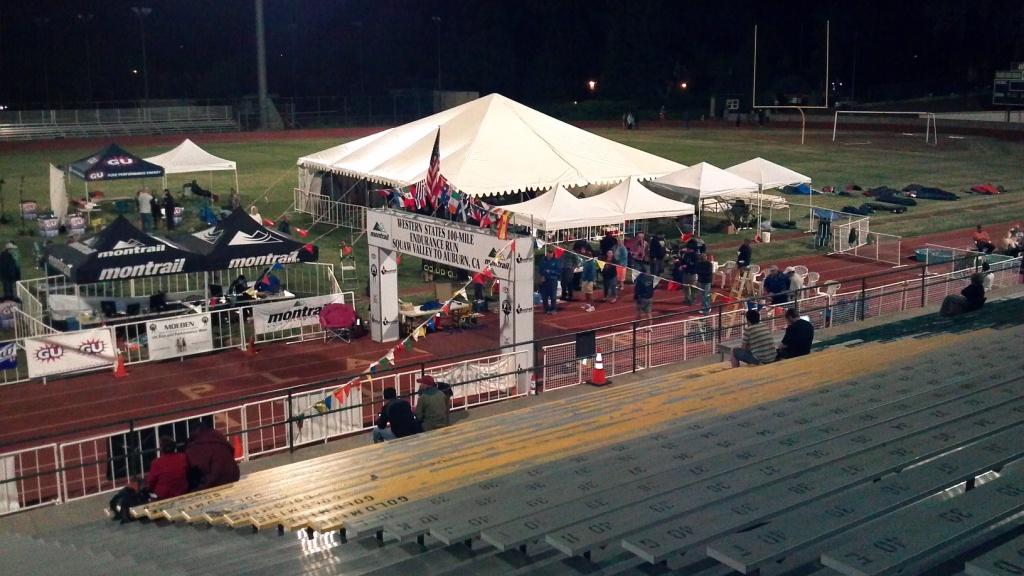
 Western States right before the start. Can't wait for my moment here! I'll be inserting a pic of my own here of this year's start.
 .....

My first ultra this year, the Long Island Greenbelt 50k, has come and gone. Except for a few muscle cramps here and there, I'm doing fine.

Wound up doing a 2000 meter swim workout this morning. Along the way, I got cramps in both my arches of my feet. It's definitely uncomfortable, but I've learned to keep swimming with it. Muscle cramps, as painful as they can be, are fleeting. That means that the painful episode will go away after a minute or two.

-----

It's the middle of May, and the temps will never break 60 degrees today. What gives? This has to be the coolest spring I've ever experienced in my life! I mean, the cicadas that are due out this year don't want to emerge out of the ground!

I'll be going out on my bike today for an easy workout and I still have my winter clothes out. Not cool.

I don't usually complain about the weather, because it is ultimately futile, but it is worrisome this year. The Western States canyons can easily reach 100 degrees or more on some hot summer days and I do not want to be caught unprepared for the temps at the bottom of those canyons.

I'm usually impervious to the hot temps, but it takes two good hot weeks of training to get that way. With 7 weeks to go there isn't much time left for the heat to show up.

One of the things I've been doing is hitting the sauna after my swim workouts at the YMCA. The problem with that sauna is that it doesn't usually get about 120F in temperature, so the whole little sauna thing might be futile.

We'll see. If the worst case scenario does happen, I know I can still slog through Western States if I have to.

-----

I've concocted a 44 mile run this Saturday on the Appalachian Trail between the Manitou Train Station and the Appalachian Trail Train Station.


I have a 10.5 hour window to make the 44 mile journey, which amounts to a little slower than a 14 min/mile pace. I think I can do that.

Still, the long mileage can yield unpredictable results, so I am taking a bit of a risk in not making the trains. That's OK. If worse comes to worse, I will have my cell phone on me, and if I miss that last train back to Grand Central terminal, I should be able to hit a hotel in Pawling, NY for an overnight stay.

----

What is with finisher's bling and the desire to finish a race? It's an interesting thing to see people, including me, go all out to finish a race just to get a perfectly ordinary finisher's metal that I've gotten plenty of times before.

I mean, the medal I earn will only be in a box collecting dust with my other finisher's medals, right?

This came up because I was talking to someone who struggled at the 25k race at the Long Island Greenbelt this weekend and all she was thinking was getting that finisher's metal.

This wasn't her first race. She was an experienced runner too, but the thought on her mind was that finisher's medal around her neck. I can certainly understand what she means.

I remember Ironman Canada 1998 and the price I had to pay to get my finisher's shirt there. My friends in my circle called that race, "The Hot Ironman". Temps literally about 100 degrees for most of the day. I got destroyed early in the race, at about 70 miles on my bike. Thankfully at around 90 miles, the course was a net downhill. Without that I probably wouldn't have made the transition to the marathon run.

I was literally seeing double at that point. Classic hyponatremia. Very bad. I barely coasted into T2 and tried to eat every salty food that was out there. After about 15 minutes in transition I started to walk out onto the run course.

I got better, but of course I ate too much. Boom, bad stomach problems. I did the run/walk thing for the first 13 miles as I battled with abdominal cramps, reached the turnaround and started my way back.

There was a massage tent at 14 miles. I couldn't resist. I went in.

After 15 minutes of deep tissue massage, they put me back out onto the course, and into the hot sun. I felt dizzy.

One rule to note here...never do a deep tissue massage during a race.

With 12 miles to go, I was ready to quit. But, nope! I had to get that finisher's shirt! I walked the rest of the way back toward the finish line. It felt like forever. I really wanted to drop out. But that finisher's shirt was on my mind!

And it got me home. It was my slowest Ironman ever, but hey, I got my finisher's shirt!

So after racing so many years, I still do understand what that struggling runner meant this weekend.

As a matter of fact, I still wore my 50k medal I got this weekend with a bit of pride to. Yes, it'll go in with the numerous other finisher's medals I got.

But I still earned it, so I'll continue to wear my finisher's medals with pride.

-----

Had a very vivid dream last night. It felt like someone was trying to communicate with me on a different level of consciousness.

I do believe that there are different levels of reality or consciousness that people are connected to, and strong emotions can somehow carry their way across these different levels through to other people.

Yeah, I know that some people might consider this hocus-pocus, but hey, can anyone ask me fully if they fully understand the reality we live in right now?

I mean, we got teams of scientists doing so many research projects just to try to understand our reality right now. Guess what? Even with all the data they're generating (Higgs Boson, uncertainty theory, wormholes, etc.), they STILL don't know jack about our surroundings.

And yes, I was a scientist in my heyday too. I'm sorry, but if you just rely on their data that this is the only reality that is out there, then you really have a very dim view of the world.

And I think every ultrarunner knows that we are much more capable than even scientists think humans in general can. That is why you still see them research us in 100 mile races.

Anyway, I leave you with that thought, that we are capable of so much more than we think. Remember that, focus on that, and get out there and do something amazing!


Sunday, May 12, 2013

Long Island Greenbelt 50k Race Report - No Guts, No Glory

Today was the day the new, leaner me was put to the test.

The night before, some thunderstorms swept through the area, waking me with a jolt. With thunderstorms in the forecast for race day also, I knew it was going to be a sloppy, wet day.

I was one of the first to arrive at the race venue, the reason being that the Brooklyn-Queens Expressway was part of the drive to Long Island, and that expressway is notorious of having heavy traffic, even on weekday mornings. The BQE was thankfully tame this morning, and I got there with plenty of time to spare.

Once there, I quickly got my bib number (#44) and got myself ready for the race. Since this was going to be a wet one, I made sure I lubed up every body part with Bag Balm to avoid any chafing (it worked like a charm). 

I met several familiar faces. Zandy Mangold, a very talented ultra runner, was ready to tackle the course. Cherie Yanek, fresh off her 50 miler at Bear Mountain, was ready for her 2nd ultra in as many weeks. Right before the race started, I also saw Bob Wisner arrive for his 25k race that started one hour after our 50k.

My strategy was an aggressive one. With my weight officially at 177 pounds, I wanted to really see what would happen if I pushed myself to the edge.

We started off promptly at 7:30. For the first couple of miles, I settled into the second lead group of runners. The first part of the trails were generally downhill, so our pace was aggressive from the outset. I was with this group all the way toward the northern end of the trail.

The northern end of the trail is perhaps the toughest part of the course. With its steep ups and downs, and littered with rocks and roots, our group quickly started to break apart. I decided to walk some of the uphill sections as it was still early in the race and I didn't want to wear myself out too quickly. By the time I crested the last hill and descended the last downhill to the aid station at the turnaround, I was in 9th place overall.

I quickly replenished my water bottle and ended up around 7th place as I left the aid station on the way back. We settled back into a group again as we finally left the difficult hilly section and back to the gentle section. At this point I saw Cherie Yanek running towards me on her way to the turnaround. She joked to me that the finish line was only a half mile away, a dig at the erroneous info that I gave her about how far out she was to an aid station a week ago at Bear Mountain. I joking replied that I believed her with all my heart.

Several miles more and I started to see the runners of the 25k race coming toward me. Bob Wisner came by and we quickly acknowledged each other. He's been looking very good at these races lately. 

At the close of the first lap, I still remained in 9th place.

The second loop, of course, was definitely going to be the test. How long can I sustain an aggressive pace? Two of the runners in the group in the first loop, started slowing down ad I passed them to get into 7th place.

Midway out on the 2nd loop, the weather made a turn for the worse.

The skies grew dark, the wind whipped up, and we experienced heavy rain. The course was sloppy to begin with, but now the course got downright slippery and dangerous. In some sections, the trail turned into small rivers. It got real ugly really quick.

With the rain heavy, we entered into the difficult northern section. Zandy appeared and quickly passed me, shouting words of encouragement.

About a couple of minutes after Zandy passed, that is when I had my intimate contact with the mud.

I always had a rule when trail running. When the trail is wet and slippery, I always step down the center of the trail, where it is flat, no matter how rough it is. The reason is that the edges of the trail are sloped, and sloped trails greatly increase the chance of a slip and fall.

I didn't follow my own rules. On a particularly steep downhill section, I settled for the edge of the trail, my right leg took out my left leg, and I quickly fell down on my right side and rolled onto my face.

I was fine. I was caked with mud, and I looked real bad, but I had no injuries and proceeded to press on as aggressively as before. Some of the people asked me if I was OK, and told them I was. I also joking told them I wear the trail very well.

I finally got to the turnaround station and got out quicker than some of the other people, quickly getting 6th place. I still remained in a group, but as the last miles rolled by, some of the faces change, as some runners started to slow down. They were quickly replaced by other runners behind me who kept a good fast pace.

On the way back towards the finish line again, I met Cherie again. She saw me all caked with mud and jokingly asked me if I had an argument with a mud puddle. I think I said I did, and the puddle won, lol.

I held my own. I teetered between 7th place and 10th place throughout the remaining miles. I only started to slow down in the last 2 miles of the race. As Zandy passed me for the last time he encouraged me to run with him. Although I couldn't match his pace, I was still running by the time I reached the road a half mile from the finish. I finished off in 9th place, only a minute behind Zandy. Official time for my race was 5:11:58, a very good time considering the sloppy course.

(Official results of the 50k race can be seen here)

I was very strong throughout the entire race, something I can definitely attribute to with all the hard work I did in training in the spring and the change of diet that allowed me to lose a lot of weight. I will definitely never go out at an aggressive pace in my 100 milers, but it's great to see I have a lot of strength in my running, especially on the hills.

One other important thing to note...my legs are a little tired, but not sore at all. I have every reason to believe that my legs will be close to 100% in only a couple of days. This is very important because I will need the quick recovery during the short periods between the 100 milers of the Grand Slam of Ultrarunning. If I can recover as quickly as this, it will give me a greater chance of actually completing the Slam.

Saturday, May 11, 2013

How to Prepare for Race Day

A very short blog this morning before I go off to the races this morning.

How did I prepare for this race.


First, I knew exactly what type of race I'm doing. Today, I'll be the Long Island Greenbelt 50k. It is a trail race. It is two loops long. It also has a 25k race which is only 1 loop long.

I also note the small details of the race that might prove to be bigger than thought. In this race, the 50k starts at 7:30AM, but the 25k starts at 8:30AM. So the 25k and 50k races start off at different times. This might sound small but is a real big deal. Another race I know, the Staten Island Greenbelt Festival race in December, also has a 25k and 50k race, but starts off together. Why is this a big deal? Because in general 25k people will run faster than 50k people and the 50k people might get influenced by the faster 25k crowd. The race in December can be very tricky as the 50k people need to be careful not to run as hard as the 25k crowd, then blow up toward the end of their race.

With the race today, since the two races run at different times, there will be no influence by the 25k crowd on the 50k people. That's definitely a good thing.

Another thing I look at with races is the terrain. This is especially true if it was a trail race. Here's the map I looked at for this race.


This map is doubled for 50k. The map tells me that although Long Island might be mostly flat, I shouldn't be deceived for this race. The hills are manageable, but the race DOES have hills and will expect to climb a fair bit for this race. Since this is a trail race, I will bring my minimalist XC flats. I do have my hugely padded Hokas, but I will be saving those babies for my Grand Slam races.

The I look to see how frequent a certain race has aid stations. With road races, this might be a non-starter, since aid stations usually come at every mile, but for trail races, this can be a BIG issue. Often with trail races, this will influence my decision of what to wear for this race. If aid stations are infrequent, then I will wear my Camelbak to carry extra water and supplies  If the aid stations are plentiful, then I will probably only carry a water bottle. In this race, the aid stations are only about 4 miles apart, so I will only carry a water bottle during the race to keep it light.

The day before the race, I also will determine what food to eat and when, because it is absolutely critical to have a settled stomach for some races, especially one as long as this one. The time I eat the night before is important because it determines whether the food will pass through completely before the race or not.

Finally, the day before the race I take a look at the weather reports to see if that will influence what to wear during the race. In this case, the weather will be in the high 60's to low 70s with showers and T-storms likely. It's probably going to be a sloppy, muddy course out there, so I'll pack in a few towels to clean off during the race. For the race itself, the temperature is warm enough to stay with shorts and a short sleeve shirt. Since the race is long and my feet will most likely be wet, I will bring a lubricant like Bag Balm to put on my toes to prevent blisters.

I'll need to bring a change of clothes for after the race so that I can slip into something drier and more comfortable. With the day being this warm I don't need to bring my jacket. Just pants, shirt, and some underwear will be fine. I'll also bring a hat because rain is likely. I will also bring in some recovery food to eat for after the race.


Lastly, I try to arrive early to the race venue to take into account any traffic that might occur from my home to the race venue. If traffic is heavy, you have the time needed to get to the venue without a problem. If traffic is particularly light and I arrive early, I can always take a small nap before the race to settle myself down even further before race time.

This is precisely how I prepare for a race like this. I do this so that there are no surprises come race day. I want to be prepared as possible so that I know exactly how to start out on a particular race and how best to complete this race in the best possible time.

You've prepared yourself physically for a big race. Race day logistics like this is also just as critical as your training, so DON'T NEGLECT THIS. Start prepping for your big race at least a month before so that you know what race you're getting yourself into and what type of strategy you're going to need. You can also build a checklist for the race so that you have the right gear to take for your race.

If you prepare the right way, race day will go very smoothly, you will have the piece of mind you need, and you will increase your chances for a great outcome!

With that, I'm off to the Long Island Greenbelt 50k. You have yourself a great race also!

Friday, May 10, 2013

Last Phase of Grand Slam Training - THE GAUNTLET!

Seven weeks to go before the Western States 100! My last recovery week is almost over, and it's the final phase of my training before the taper. Yes, it's time to kick some butt!

 I'll be looking at this map more often as the race draws closer.


I love the final phase in training, and apparently my athletes love it too.

It's great prescribing this to athletes, including myself, because this is where the rubber meets the road. This is where the training reaches a crescendo. This is where all the work done in the spring leads to.

This phase is pure intensity, plain and simple. Very little rest and a lot of work. For people doing small races, this phase has a lot of speed in it. Track workouts, bike/run bricks for triathletes, tempo runs, swim sprints, the kitchen sink, etc.

For endurance athletes, the primary staple is lot of long runs, long rides, open water endurance swims, with some speed thrown in for kicks. If the training goes well in the spring, the body should be able to withstand the miles and recover quickly.

Which leads to the training I'm doing. Grand Slam training. The ultimate in endurance training. I am now going into my final phase.

The ultimate phase for the ultimate training schedule? I call it THE GAUNTLET!


THE GAUNTLET. Five weeks of hellish training with little or no rest. Lots of long runs and rides planned during this final phase.

I'm mentally prepared. Yes, I've indicated that fitnesswise, I am definitely ready for the Slam at this time.

But I cannot rest on my laurels. Somehow, just trying to maintain this fitness for the last five weeks will cause me to lose my mental focus and edge. To say that "I have arrived" loses all incentive to keep pushing forward. I just feel that if I approach the last five weeks this way, I will lose all incentive to push and will end up with five mediocre weeks leading to Western States.

The goal here is to keep the mental edge by raising my expectations and goals even more; to try to reach an even higher level of fitness and not be satisfied with the fitness I have now.

All within the bounds of staying injury-free, of course. Everything is tempered by biofeedback. I always stress that as a coach and I use it all the time. Always have to listen to your body and know when to back off when needed. Train to the very edge of overtraining but do not cross that line. If that means missing some miles, then so be it.

So here are the goals for THE GAUNTLET. Remember that I'm using the triathlon approach toward The Grand Slam of Ultrarunning, so there's a lot of swimming and cycling here as well as the running:

Tomorrow (May 11): The Long Island Greenbelt 50k - I'm racing this pretty hard.

Week of May 13-19: 8000 meters of swimming, 80 miles of cycling, 80 miles of running...highlight will be a 2 day Appalachian Trail run/hike.

Week of May 20-26: 10000 meters of swimming, 120 miles of cycling, 50 miles of running...highlight will be about an 80 mile bike that weekend with the Staten Island Triathlon and Ultra Group.

Week of May 27-June 2: 8000 meters of swimming, 80 miles of cycling, and 80 miles of running...highlight will be 34 miles of the Delware and Raritan Canal Towpath at around an 8:30 min/mile pace at the RVRR Train Run.

Week of June 3-9: 10000 meters of swimming, 100 miles of cycling, and 80 miles of running...highlight will be a 34 mile Appalachian Trail Run done with the NY Flyers Trail Group and NY Ultra Meetup Group, the last long run before Western States.

Week of June 10-16: 8000 meters of swimming, 100 miles of cycling, and 50 miles of running...highlight will be a longish 60 mile ride in NJ with the Staten Island Triathlon and Ultra Group to finish THE GAUNTLET.

Will I reach those goals. Not sure, but I will try. Again, if I cross the overtraining line at any time, I will back off. But I'll definitely give it one heck of a shot.

A two week taper will follow after that, and then, hopefully a good result in the Western States 100. But I have my work cut out for me. But I feel up to the challenge. Let's do this!

Thursday, May 9, 2013

Initial Western States Strategy

With a little over 7 weeks to go before this no-name small-time endurance coach representing Staten Island starts his little quest for one of ultrarunning's grandest prizes and starts with the first race of the Grand Slam of Ultrarunning at the Western States 100, strategy now needs to be addressed.


I'm not one to really discuss strategy of my 100 mile ultras, because by the time mile 60 comes around, most of my strategy would have been abandoned for something simpler, like, "left foot, right foot, ugh, must...make...finish...line"

But Western States is a course that needs to be addressed. A person can make or break his or her race with the first 62 miles of the race. The first 62 miles involves lots of hills and canyons; in other words, ups and downs in very isolated areas. The last 38 miles is a lot more urban and gentler on the legs. Or so they say.

El Dorado Canyon, one of the canyons I have to traverse in the Western States 100, is definitely breathtaking, but can be dangerous if one runs out of nutrition and hydration since it is so isolated.

With this race I will have no crew, but will have a pacer at mile 62 and places to put drop bags. It is very important to know what to start out with and what to put into these drop bags so that I can come out of this with a decent time.

First things first...what shall I be wearing at the start line? With the potential for cool weather at the start (this is the Squaw Valley Ski Resort we're talking about here), I must have the option of switching from long sleeve shirts to short sleeve shirts. A change of clothes on the fly can only happen if I wear a Camelbak for the start.

I'm not too keen on having additional weight for these races, but in this case, I think it would be necessary to have the Camelbak on hand. I can store extra clothes in the back, along with first aid items like Bag Balm and Band-Aids. With the difficult trails in the beginning I just want to make the first 62 miles as comfortable as I can. Plus, with all the extra water I can store in the Camelbak, I have virtually no chance of running out of water in the long miles between aid stations. Especially in the canyons, when I do not know how fast I'll be climbing the switchbacks and how long I might reach an aid station. The extra water will definitely help.

With all the weight that I did lose for this, certainly it would be fine to carry an extra pound or two of water on my back. The extra weight should affect my pace or my ability to climb hills at all.

After 62 miles, when I arrive at Foresthill and obtain my pacer, I hope to be well enough to run a little faster since the course is friendlier and the aid stations closer together. I can leave my Camelbak in my drop bag there and run light the rest of the way with just a hand-held bottle.


Anyway, it sounds like an OK plan for the time being. As with nutrition and hydration, well, I will do it exactly as I did in Vermont last year. Go mostly primal, of course! Bananas, watermelon, canteloupe, grapes, and lots of water. I will take the occasional sugary item, of course, but I'm hoping to stay away from those since they are double-edged swords; they may make me feel better immediately, but may make me worse down the road.

Hopefully, with this strategy for the first 62 miles in place, it will keep me well enough to keep me running for the last 38 miles and help me finish this race with a decent time.


Wednesday, May 8, 2013

The Search For an Off-Road Ironman

I think insane thoughts all the time.

But I like it. That is what makes me, well, me.

Apparently, I'm not alone though. Especially when it comes to triathlon and ultras. And maybe marrying them together to get a great new endurance sport.

About a decade ago, a lot of us triathletes were actually thinking about taking the Ironman distance (2.4 mile swim, 112 mile bike, 26.2 mile run) and actually going off-road with it. Not just off-road though, but with extreme terrain consistent with some of the ultrarunning races.

And some person actually had a great venue for it! Rifle, Colorado. Perfect mountainous terrain, finishers would come in around 24 hours, just like the 100 mile ultramarathon, it would be great.

The event did actually sell out at 200 people, but for some strange reason, the event was cancelled.

Although the idea was still floated around many times, I don't think anyone really took it seriously.

Until now.

I just did a Google search and found this little gem, the X-Man UK, set to go off on July 14 of this year.


According to the website, the bike is extremely grueling and much of it would take place at night. Perfect!

Although my season is already set this year, I might actually try entering into this race next year, if it happens, and if it is as grueling as it seems.

Plus, if a person or sports company can actually set one of these state-side this year, I would be the first to sign up!

Maybe it's now time to tune my mountain bike up. :-)

Tuesday, May 7, 2013

The Coming Mental Ordeal Of The Slam

With this Grand Slam of Ultrarunning craziness bouncing around in my head every minute of the day since the Western States lottery, my thoughts had to eventually come down to this: strategy.

I mean, how can one do another grueling 100 mile ultra a mere three weeks after finishing one? How does one get his or her legs to recover fully for those three weeks between races?

An even better question to ask yet is, can one get his or her mind ready for another ordeal after the previous ordeal is fresh on the mind?

By the time the Slammers hit Hope Pass in Leadville (above), they will have already accumulated 240+ grueling miles on their legs over 7 weeks.


These are the questions that I'm going to have to answer truthfully if I want to successfully finish this Slam.

The mental aspect of the Slam really doesn't start at the starting line of Western States 100 in June. At that point, I would probably be excited and raring to go.

No, the mental aspect really starts the moment my first crisis happens during the Western States, how I get through it, and how much of it I remember as I toe the line at the second leg of the Slam, in Vermont three weeks after Western States.

And how much of the misery of the first two races would be on my mind as I toe the line at Leadville four weeks after Vermont. I'm willing to bet that with each successive race in the Slam, the misery will accumulate and build.

That is why I think there is a tremendous failure rate in completing the Slam. Of course, the physical aspect of these long races are evident, but how much of an ordeal can one mentally take with four 100 mile races in ten weeks? I think THIS is the real question that needs to be answered by me and by everyone else attempting the Slam.

I have been doing a great bit of Transcendental Meditation this year, hoping that by generally shifting my thoughts from the pain of it all to being only in "the moment" that hopefully I can find the mental fortitude necessary to finish the Slam. Dwelling on the pain of past races and anticipating the pain of the coming ones is not going to get me through the Slam.

It's as simple as that. When I'm running at mile 60 in Vermont, I do not focus on the struggles that I had in Western States three weeks before, or focus on what might happen at Hope Pass in Leadville four weeks from then.

I will have to stay in the moment and focus only at mile 60 in Vermont.

Of course, it's a simple strategy, but is it simple to implement?

For my sake, I hope that the meditation makes it so. It's going be one long hellish summer, that much I understand. But if I can cut the summer down to one moment at a time, I might actually stand a better chance at completing this thing.

We will start to see in 8 weeks time.