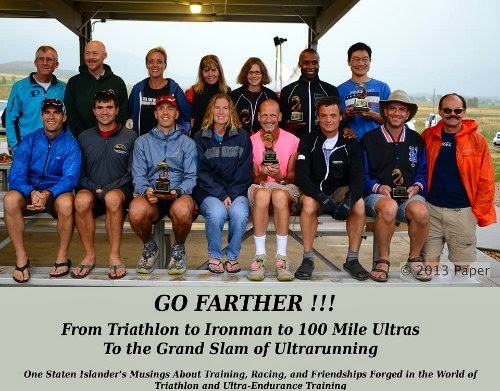
A Staten Island triathlete and endurance coach ventures into the ultramarathon realm where there are seemingly no limits to human endurance. In 2013, he will be attempting the Grand Slam of Ultrarunning, a gruelling attempt to finish four of the oldest and most prestigious 100 mile ultramarathons in the U.S. in only 10 weeks, in which only 234 people have completed since its inception in 1986.

Sunday, May 19, 2013

A Week To Step Back into Triathlon Training

I love triathlon training!

Me in last year's Staten Island Triathlon in August (9th overall, 2nd in age group)

I'm in the middle of that group of insane triathletes trying to sink a platform at Ironman Canada. Swimming can be fun also. :-)


After a tiring 22 mile run up and down rock strewn steeps on the Appalachian trail yesterday and a longish run today, I can slip my body back into the other two disciplines to change it up so that I can give my tired running muscles a rest.

Those people who only run for fitness would either have to back off a bit or keep the running ramped up and risk injury.

The plan this week is to do about 10,000 meters of swimming this week, with some intense sets such as my 2 mile non-stop swim and some 200 meter Individual Medleys (IMs) with only 20 seconds of rest in between the IMs. On the cycling front, I will be doing a nice long 60 mile ride in NJ.

This swimming and cycling stuff is kind on the legs, but they do wallop my cardiovascular system!

Because of that very reason, the swimming and cycling will play a HUGE part in the days between the Grand Slam races, being very gentle with my legs while keeping the body primed and ready for the next 100 miler.

After this week, I will be back to my running form again, doing the Raritan Valley Road Runners "Train"ing run, going the whole length again for 34 miles. Gotta watch out though...these guys go at an 8:30 min/mile pace, so there is some speed involved.

The following week will be my last long run, going back to the Apalachain Trail with some of the NY Flyers and the NY Trail and Ultra Group near Pawling, NY for an out-and-back of over 20 miles. Since it would be only 3 weeks to go, I will be taking it quite easy and letting the "speedsters" go off to parts unknown for longer distances.

After that, the work is done! Whew! I can't believe it's almost over.

In summary, I think this spring utterly transformed me in many ways, but, that will be addressed in a future post. :-)

Yikes! 44 Miles in 10 Hours on AT Too Ambitious

Well THAT didn't work!

My plan was to run the 44 miles of the Appalachian Trail. starting from the Manitou Train Station at 8:49, then run the 44 miles to the Appalachian Trail Train Station near Pawling, NY. I was supposed to get there by 6:39PM, when the last train leaves. It amounted to about a 14 minute mile pace. Certainly, it should be easy to get done, right?

Whoa, hold yer horses!

Um, methinks I forgot how technical the Appalachian Trail can be in that area!

Yesterday, the stretch of AT I ran yesterday, probably only 20% of the trail was runnable. The rest is a boulder strewn mess of steeps that involved mostly scrambling and walking.

In the beginning of the run, I met up with Chris and David who knew a lot more about the area than I did. Chris knew that my plan was a pretty ambitious one because he's run these trails and knew how difficult it was. Chris parked his car at the half-way point of the run and his wife drove him down to the start at Manitou.

Anyway, in the beginning, we settled into a pretty brisk pace on the trails. The first 5 miles of the trail were strewn with rocks, but was actually quite runnable. We emerged onto Rt. 9 and the convenience store there.

After going to the bathrooms and restocking our supplies, we started to push forward onto some of the hillier sections of the course. This was where the course started to get more difficult.

Chris and David were good people to have a conversation with. Chris knows the Leatherman's Loop in that really well. I told him that next year, I would love to do the race itself since the nature of that course was right up my alley. Along the way, I was also talking to David about my coaching theories and how both triathlon and ultrarunning gave me a unique perspective on training in general.

We ran to the road on the outskirts of Fahnstock State Park and rested as we replenished our water with a faucet found along the AT there. We ran a hard pace to that point, got 12.5 miles in; I found that the technicality of this course has slowed us down to the point where getting to the AT Train Station was in doubt.

So I tell Chris and David that the best thing to do at this moment is to turn back and make it back to Manitou in plenty of time to get the train back to Grand Central. Chris, who had his car at the mid-way point of the trail, offered to drive to the nearest Metro North train station once we got to his car in 10 miles or so. Since I was exploring these trails for the first time, I took him up on his offer and we pressed on into Fahnstock State Park.

This is where the trail REALLY got technical. The day was warming up a lot and both David and I were actually feeling the heat. It takes me two good hot weeks to get me used to heat training, and with this cool spring, I was definitely feeling it flush on my face. I was happy that I was finally getting exposed to the heat now because I need to be used to it by the time Western States rolls around.

Most of the trail in Fahnstock was mostly rocks and boulders; we had to scramble up and down these rock-strewn hills, slowing our pace down considerably. The drastic ups and downs on the course were also pretty much starting to take a toll on the legs with the hard pace we were pressing. I was secretly glad that Chris had a car parked 5 or so miles away.

About a half-mile away from that road was a nice overlook. We stopped and rested a little at the top for about 10 minutes before making the final descent towards the parking lot. By the time we got there it was already past 2:30PM. Making some quick calculations we traversed 22 miles of hard technical running in about 5.5 hours. With 22 miles left to go to the Appalachian Trail Train Station, there was very little chance that I would make it before 6:39PM.

So we got in the car and he drove me to the Cold Spring Train Station where a train back to NYC came. The ride home was pretty much uneventful.

Even though I failed to make it to the Appalachian Trail Train Station, it turned out to be a great day of running anyway. One can never beat exploring new trails or trying a new challenge. This was both, and getting to know some of the ultrarunners in the NYC area a little better was worth it.

-----
One little hiccup in yesterday's run was the travel there. And, of course, it involved government again.

I was replenishing my Metro-Card at a machine, adding $4.00 to the card. I slide the Metro-card into the machine, plunked in $4.00 when it asked for it, and waited until the machine spit out my card.

To my surprise, the screen says "failed to add to account", spit out my card, and didn't spit out my money! It also gave me a receipt saying that it failed to properly add value to the card.

So I did what any person would do and take the receipt to the clerk to get my money back. Instead of money, the clerk gives me an envelope, telling me to "mail the receipt" to this address and I'll get my money back!

I stared at him and said,"You have to be kidding me!"

He goes, "That's the policy"

I go, "Well, your policy sucks. How long is it going to take, 6 weeks to get my money back?"

He says, "I don't know".

Government bureaucracy. I can't stand it. I'm glad I didn't add $20.00 to the card. Jeez!


Friday, May 17, 2013

My Weekend Plan - Running 44 Miles on the Appalachian Trail

I know it's getting close to the Grand Slam of Ultrarunning when I'm regularly planning these long, long trail runs in an isolated area somewhere!

Well, this one is going to be a bit of an experiment. And a bit of risk.

Here goes...there is a 42 mile stretch of Appalachian Trail that spans between two train stations of Metro North I will be dropping off at the Manitou Train Station close to the Bear Mountain Bridge, find my way about a mile or so onto the Appalachian Trail, and there I run/hike all the way to the Appalachian Train Station near Pawling, where I hope aboard back onto the City.

The map of the route going from the Hudson to Pawling NY.

The times are quite critical - if the train is on time, I'll be at Manitou at 8:49AM ready to rock-and-roll.

The schedules for pick-up at Appalachian Trail are either 4:44PM or 6:39PM depending on how fast I arrive. The risk is that I must make the Appalachian Trail Train Station at 6:39PM or I'll be stranded for the night.

Arriving at the trail station at 4:44PM will give me 7 hours and 55 minutes of hike time. This would leave me at an aggressive 11:05 min/mile pace to make this train. That's going to be a humdinger of a run! I might set out at that pace and see how far I get with it though.

The later time, 6:39PM, will give me 9 hours and 50 minutes of hike time. This would leave me at a much more leisurely pace of 14 min/mile pace to make this later train. I *should* be able to make this pace above all else.

But it's a long run, and there is always a risk that I might not make both trains at all if I develop complications during the run.

If that's the case, I can run the extra 2 miles to Pawling itself and stay there for the night. I hope that's not the case though.

The idea here is to get as many miles as I can on my legs tomorrow. But, the other significant aim is to have fun exploring trails in my area that I've never done before.

And fun is why I keep running. If this wasn't any fun I would never do this ultrarunning thing at all. :-)

If anyone else wants to come, let me know. In the meantime, wish me luck tomorrow! :-)

Thursday, May 16, 2013

I'll Take Trails Over Roads Every Time!

Trail running vs road running. I've seen a lot of intense debates all the time in running forums.

There is a BIG reason why I converted big-time from road running to trail running.

The freedom to travel EVERYWHERE!

I'm not limited to a strip of asphalt when running in far off places. For example, I don't have to see the White Mountains of New Hampshire from afar while on the road. I can actually go up INTO the White Mountains and see the scenery up close.

And this is enhanced nicely when running ultramarathons. This year, I will be doing the Grand Slam of Ultrarunning, and ALL FOUR of these races are in such beautiful places that I am willing to take an action cam with me as I run them to take a picture of the views.

I picked some random pictures from the web of the four races of the Grand Slam and tell me why I should prefer road running over trail running.

Western States 100

 Beginning of Western States, Emigrant Pass, going downhill.

Red Star Ridge - Beginning of Race

Unbelievably beautiful. I am glad to get the opportunity for Western States!

Western States Trail near Squaw Valley - Why run on the roads nearby when the trails takes you THROUGH this!

Vermont 100

I've been here twice before, and it's great up there too. I have my own pictures, but will only post the scenery only for this blog entry.

The Start Line...Majestic!


Most of the scenery is like this, rustic little farms in a green, rural setting.

Around Mile 28 of the race. The horses are with the runners early on, adding to the beauty of the race.

The hills are alive, with the sound of music! Ahem...sorry. Great vistas here though

Leadville 100

I quickly fell in love with the Rockies when I went to Leadville 2 years ago. I didn't make the finish, but vowed to come back, partly because of unfinished business, but mostly because of these views!

Above the treeline! Hope Pass. With Twin Lakes in the background.

The COLD stream crossing at the foot of Hope Pass.

Powerline Hill at Mile 82 - Rugged Beauty

Wasatch Front 100

This race is perhaps the most beautiful and scenic of all four races. If this race doesn't kill me first, I will be definitely soaking in the vistas in this great race!

The view like this will be stunning for most of the race!

The pics are just breathtaking, it's going to be even better seeing it first hand!

Roads? Where we're going, we don't need roads!

The Wasatch Front Range. Just a quick little run through them. A little hilly though... ;-)

There's a whole big world out there than just the Triple Crown. And most of that world cannot be reached by roads. Trail running gives me the complete freedom to touch the tops of the mountains themselves, to enter and traverse different canyons (including the Grand Canyon!), and to see exhilarating vistas that no road can deliver. 

And since trails are, well, NATURAL, only a small percentage of trail runners suffer chronic or permanent injuries as a result. 

So if you're one of those road runners that have treated trail runners as second-hand runners (yes, I know a lot of you personally) take a look at these pictures and tell me if you can honestly find more breathtaking views from a strip of asphalt.

Thank you.

Wednesday, May 15, 2013

Hard Effort vs. Easy Effort - A Small Primer


Every now and again, I need to explain some of my basic fitness theories so that people actually "get it".

I've posted numerous articles about Periodization and the "hard day, easy day" approach. And most athletes, including beginners, have heard about this.

But most athletes, even experienced ones, don't realize the SCOPE of the difference between "easy" and "hard". What they think is "easy" is still a pretty hard pace, thus not giving their bodies the time to TRULY recover from their hard workouts. A lot of injuries result from this problem.

If you're running a 9 min/mile pace for your hard pace, a 9:15 min/mile pace is not what I think of as an "easy" pace. You'll need to go slower. A LOT slower.

So, let me try to clarify in layman's terms what it truly means to go easy, and maybe this will help people understand what hard and easy means.

Hard is when you strap on your watch, and turn it on when you begin running. Easy is when you leave your watch at home and forget about timing your run.

Hard is when you go on a set course with a certain time to finish in mind. Easy is when you try a totally new course to explore.

Hard is when you get the tunnel vision, focus inward, and concentrate on your focus and efficiency to move you faster. Easy is when you focus outward, soak in your surroundings, and enjoy the scenery as you go.

Hard is when when you put your game face on and mean business. Easy is when you strap on your shoes and put a big smile on your face because your aim is to have a bit of fun during your workout.

Hard is when you are a bit run down and tired after a good intense workout. Easy is when you feel energized and not the least bit run down at all after a workout.

Hard is when you know from your tiredness that you need an easy day to recover after your intense workout. Easy is when you finish your workout excited and itching to get at your hard workout the next day.

I hope this makes the difference between easy and hard clear. As a rule of thumb, I always tell my endurance athletes that, when running, your easy pace should be at least 90 seconds slower per mile than your marathon race pace, and ideally should be 2 minutes slower per mile.

In the case above with the 9 min/mile pace, your easy pace should be around 10:30-11 minutes per mile. YES, that is what I mean by easy!

Most of my athletes, when they do this easy pace, have said that their run feels "ridiculously easy". RIGHT!!! It's supposed to be that way. All your workouts need not be hard ones that sap your energy all the time.

You'll definitely lower any chance of injuries if you do your easy workouts, well, EASY! Only then will you safely ramp up your weekly mileage volume to levels that you didn't think was achievable before.

Trust me on this.

Tuesday, May 14, 2013

Wheat: Friend or Foe - A Rebuttal

The Staten Island Advance yesterday posted an article in their health section called, "Wheat: Friend or Foe?", an article by Dr. Sharen Palmer that tries to "dispel the myths" that wheat is bad for you and that whole grains do have "a proper place" in people's diets.

You can see the article here.

There are some items in this article that we really have to take a look at here...

Julie Miller Jones, Ph.D., Distinguished Scholar and Professor Emerita of St. Catherine University in St. Paul, Minnesota, believes that wheat has become today’s diet scapegoat. Jones, who is an expert in the field of grain science, says, “There is no evidence that wheat is bad for you, with the caveat that you eat the right amounts as recommended, and make half of your grain servings whole grain. There is a staple grain or starchy tuber in every culture—in our culture it’s wheat. We’ve been cultivating and eating wheat for centuries, and perhaps the only bad thing about it is that for the last 50 years of eating wheat, we’ve been sitting down too much and not cultivating it ourselves. So, we’re attacking the wrong demons.”
No evidence that wheat is bad for you, huh? Just like the cigarette industry said back in the 1970s that cigarettes weren't harmful for you? Or the shoe industry "citing sources" that their overly built-up running shoes with "state of the art" cushioning is not bad for your legs?

Please. You sound like just one of those people trying to defend the establishment and their FDA and Big Agriculture sponsored food pyramid scheme. But you want evidence that wheat is bad for you, huh? OK, let's get into the details...

Growing wheat. One popular notion is that wheat has been genetically altered by humans to the degree that it is no longer good for us. However, Jones explains that the common plant foods you eat every day—lettuce, tomatoes, corn—have been modified countless times over the years through traditional cross-breeding methods, which farmers use in order to bring out the best attributes of crops. “Your grandmother and grandfather were seed savers—they saved the biggest, sweetest seeds and planted them the following year,” adds Jones.

This goes far, far beyond individual farmers just hand-picking the good seeds from the bad seeds. There's a huge experiment that has been going on for decades (and is still ongoing) about increasing wheat yields called the Broadbalk Winter Wheat Experiment. This article on Mark's Daily Apple explains in full detail why wheat genetically modified on such a large industrial level is harmful for you...

In 1843, agronomists at Rothamstead Research Station in Hertfordshire, England began what would become one of the longest-running continuous agronomic experiments in the world: the Broadbalk Winter Wheat Experiment. For the last two centuries, generations of scientists involved in the experiment have grown multiple wheat cultivars on adjacent plots of land and applied different farming techniques and fertilizers to study the effect on yield, nutritional content, and viability of the crop. They’ve rotated crops in and out, switched up fertilizers, and tracked the change in mineral content of both soil and wheat grain. It’s a stunning example of a well-designed, seemingly never ending (it continues to this day, as far as I can tell) experiment.
Between 1843 and the mid 1960s, the mineral content, including zinc, magnesium, iron, and copper, of harvested wheat grain in the experiment stayed constant. But after that point, zinc, magnesium, iron, and copper concentrations began to decrease – a shift that “coincided with the introduction of semi-dwarf, high-yielding cultivars” into the Broadbalk experiment. Another study found that the “ancient” wheats – emmer, spelt, and einkorn – had higher concentrations of selenium, an extremely important mineral, than modern wheats. Further compounding the mineral issue is the fact that phytic acid content remains unaffected in dwarf wheat. Thus, the phytate:mineral ratio is higher, which will make the already reduced levels of minerals in dwarf wheat even more unavailable to its consumers.
Increased yield leading to dilution of mineral density is one possible explanation for the reduction in wheat mineral content, but modern wheat has shorter root systems than ancient wheat, and longer roots allow greater extraction of minerals from the soil. Some people have proposed soil mineral depletion as the cause of reduced nutrient content of food, but – at least in the Broadbalk experiment – soil mineral content actually increased over time.
In other words, after years of industrial-level genetic modification, the wheat that is in production today is markedly different than the wheat of old. Such wheat is turning out to be less nutritious and more toxic for the everyday diet. Farmers hand picking good seeds from bad would never yield this type of wheat at all.

But hey, let's get back to this article by Sharen Palmer, OK?

Wheat and weight. Perhaps the most popular concern over wheat centers upon weight. Wheat-free proponents suggest that avoiding it can help you lose weight—if you eliminate wheat, you’re essentially on a low-carb diet.

According to Jones, “Studies show that low-carb diets can cause rapid weight loss in the first six months, but that people weigh more in two to three years, indicating that these diets are very hard to follow.” Any time you restrict your diet significantly by eliminating a major food group, such as wheat or dairy, calories typically drop and weight loss occurs. And so it shouldn’t be a surprise that many wheat-free dieters report—anecdotally, without published scientific findings—that they have lost weight.
OK, so what she did here is built up a "straw man" type of argument here by associating a low wheat diet to a low carb diet, then attacking all low carb diets as unsustainable. I see.

Have you ever considered fruits as a source of carbohydrates? Some vegetables? Hmmm, I think I'm getting a good share of carbohydrates there, and yes, although the amount is significantly lower than, say, a wheat diet, I'm definitely getting enough of them to live a healthy lifestyle. Plus, the carbohydrates in fruits and veggies are naturally consumed in moderation, avoiding the "sugar spike" and shock to the system that can cause complications over time like diabetes.

Let's continue, shall we?

Yet, a number of studies have found that people who eat more whole grains, including whole wheat, maintain a healthier weight. In a Tufts University study of more than 400 adults, whole grain and cereal fiber intake was strongly linked to lower BMI (body mass index), lower total percent body fat and lower abdominal fat (Journal of Nutrition, 2009.) However, if you eat too many servings of wheat or too many high-calorie products that combine wheat with fat and sugar (think donuts and chocolate chip cookies), it’s entirely possible to put on pounds.
I grew up thinking that cereals were the best for me. In my 20s, I was young enough to burn them off, but as my metabolism slowed, my weight gained considerably. Even with vigorous exercise, my weight went over 200 pounds, considered "overweight" by the BMI index that they tout. Remember, I was a triathlete, competing in Ironman races. I was NOT the typical adult who sat on his couch every day and watched TV for several hours a day.

It took a while for me to really open up my mind my diet and start accepting these "radical" beliefs that grains are actually not very good for people and that fats were in general pretty healthful. It took years for me to open up my mind because establishment people like Sharon Palmer tries to keep people like me adhering to the old dogmas of diet.

Let's continue with this article:

Wheat and disease. Wheat-free diets claim that before the cultivation of wheat humans were healthy, and that wheat is to blame for many health conditions, from diabetes to heart disease. But Jones reports, “Most chronic diseases didn’t occur in early times, because life span was only in the 30s. If anything, you could say that diets with grains have enabled a longer life. In the beginning of the 1900s, our lifespan was in the 50s and we were eating a lot of wheat. Our lifespan has continued to increase. This has to do with many factors, including diet.”
 Or you can say that other conditions improved, like health, economy, and other factors that contributed to longer lifespans as well. There's no direct evidence that our what based diet itself contributed to longer lives.

The paragraph above also talks about longer lifespans, not the QUALITY OF LIFE that goes along with the longer lifespans. There are people my age (mid 40s) that are starting to see the complications of their diets and are starting to take medication to "cure their ills". Having chronic diseases that come from our prevailing diet is really no way to go through your older years. I'm sorry, but 50 years of this wheat based diet is yielding tremendous evidence of complications in our older generation. One just has to open his or her own eyes just to see this. Dr. Palmer has got to get her head out of the sand before she can safely say that a wheat based diet is really good for you.

Lastly, let's look at this little humdinger here:

Look no further than the DASH diet (Dietary Approaches to Stop Hypertension), a dietary pattern with years of documented, proven health benefits, including weight loss, elimination of hypertension, and reducing the risk of heart attack, stroke, diabetes, heart failure, and certain types of cancer. The DASH diet is a nutritionally balanced diet that includes six to eight servings of grains daily, mostly in their whole grain form. (See EN’s coverage of the DASH diet in the December 2012 issue.)
Elimination of hypertension? I'm sorry, but when I read this, and look at my father, I have to laugh. My father is pure Italian. He loved his pasta and his Italian bread. His hypertension was so sky high that he needed medications to "regulate it". After seeing my transformation to the primal diet, he's actually cut down the amount of pasta and bread he's been consuming. Amidst all the visits to the doctor this year, his hypertension has ACTUALLY GONE DOWN to a healthy level and is now considering getting off the meds.

As for me, my increasing age has forced me to really address my dietary concerns in order to stay in top athletic shape. Ten years ago, when I was conforming to the "high carb, high grain" lifestyle, my athletic performance dropped and my weight gained into unhealthy levels. I've had very irritable bowels ever since childhood and have thought nothing of it because I thought that this condition was normal. Now that I've cut out the wheat, the grains, and switched to a primarily Paleo lifestyle, I've actually felt that I've REVERSED my age, my bowels feel normal for the first time in my life, gotten my athletic performance back, brought my weight down to a very optimal 177 pounds, and am now on the verge to do something quite extraordinary with my attempt at the Grand Slam of Ultrarunning this summer.

And to sum it up nicely, I feel FANTASTIC!

Sorry Dr. Palmer, but you really need to open up your eyes to see the mounting evidence against your case here. The shoe industry recently tried this approach with their overly built-up shoes, always citing some sort of "research" that their shoes were actually helping people when in fact there were a lot of runners out there with chronic injuries due to those shoes. When they changed to minimal footwear/barefoot running, their injuries miraculously went away! The shoe companies quickly had to abandon this approach amid falling profit and had to change their shoes for the better.

I am a scientist myself, as well as an endurance coach, and the rules of Scientific Method dictates that all scientists need to keep an open mind, acknowledge any new challenges to the prevailing theory, and proceed to experiment to see if the present theory holds or needs to be replaced. Simply holding on to dogma in the face of mounting challenges is not scientific and does not help humankind advance to a higher level of awareness.

Monday, May 13, 2013

Random Thoughts For an Ordinary Monday

Less than 7 weeks until Western States, and the excitement is building. I look back at all these weeks of working out and now I'm starting to sense the climax of the whole thing, and the inevitable end. Do I want this thing to end?


 The Watson Memorial, at the top of Emigrant Pass in the beginning of the Western States Endurance Run. After an hour of walking up 2500 feet from the start, this is the signal to actually start running. :-)


Sensing the end or not, the one thing I want to do is cherish every day of this Grand Slam buildup. It might be the only time I'll be doing this in my life.

Of course, if given another golden opportunity, I would try the Slam again. But still, you never know...

 Western States right before the start. Can't wait for my moment here! I'll be inserting a pic of my own here of this year's start.
 .....

My first ultra this year, the Long Island Greenbelt 50k, has come and gone. Except for a few muscle cramps here and there, I'm doing fine.

Wound up doing a 2000 meter swim workout this morning. Along the way, I got cramps in both my arches of my feet. It's definitely uncomfortable, but I've learned to keep swimming with it. Muscle cramps, as painful as they can be, are fleeting. That means that the painful episode will go away after a minute or two.

-----

It's the middle of May, and the temps will never break 60 degrees today. What gives? This has to be the coolest spring I've ever experienced in my life! I mean, the cicadas that are due out this year don't want to emerge out of the ground!

I'll be going out on my bike today for an easy workout and I still have my winter clothes out. Not cool.

I don't usually complain about the weather, because it is ultimately futile, but it is worrisome this year. The Western States canyons can easily reach 100 degrees or more on some hot summer days and I do not want to be caught unprepared for the temps at the bottom of those canyons.

I'm usually impervious to the hot temps, but it takes two good hot weeks of training to get that way. With 7 weeks to go there isn't much time left for the heat to show up.

One of the things I've been doing is hitting the sauna after my swim workouts at the YMCA. The problem with that sauna is that it doesn't usually get about 120F in temperature, so the whole little sauna thing might be futile.

We'll see. If the worst case scenario does happen, I know I can still slog through Western States if I have to.

-----

I've concocted a 44 mile run this Saturday on the Appalachian Trail between the Manitou Train Station and the Appalachian Trail Train Station.


I have a 10.5 hour window to make the 44 mile journey, which amounts to a little slower than a 14 min/mile pace. I think I can do that.

Still, the long mileage can yield unpredictable results, so I am taking a bit of a risk in not making the trains. That's OK. If worse comes to worse, I will have my cell phone on me, and if I miss that last train back to Grand Central terminal, I should be able to hit a hotel in Pawling, NY for an overnight stay.

----

What is with finisher's bling and the desire to finish a race? It's an interesting thing to see people, including me, go all out to finish a race just to get a perfectly ordinary finisher's metal that I've gotten plenty of times before.

I mean, the medal I earn will only be in a box collecting dust with my other finisher's medals, right?

This came up because I was talking to someone who struggled at the 25k race at the Long Island Greenbelt this weekend and all she was thinking was getting that finisher's metal.

This wasn't her first race. She was an experienced runner too, but the thought on her mind was that finisher's medal around her neck. I can certainly understand what she means.

I remember Ironman Canada 1998 and the price I had to pay to get my finisher's shirt there. My friends in my circle called that race, "The Hot Ironman". Temps literally about 100 degrees for most of the day. I got destroyed early in the race, at about 70 miles on my bike. Thankfully at around 90 miles, the course was a net downhill. Without that I probably wouldn't have made the transition to the marathon run.

I was literally seeing double at that point. Classic hyponatremia. Very bad. I barely coasted into T2 and tried to eat every salty food that was out there. After about 15 minutes in transition I started to walk out onto the run course.

I got better, but of course I ate too much. Boom, bad stomach problems. I did the run/walk thing for the first 13 miles as I battled with abdominal cramps, reached the turnaround and started my way back.

There was a massage tent at 14 miles. I couldn't resist. I went in.

After 15 minutes of deep tissue massage, they put me back out onto the course, and into the hot sun. I felt dizzy.

One rule to note here...never do a deep tissue massage during a race.

With 12 miles to go, I was ready to quit. But, nope! I had to get that finisher's shirt! I walked the rest of the way back toward the finish line. It felt like forever. I really wanted to drop out. But that finisher's shirt was on my mind!

And it got me home. It was my slowest Ironman ever, but hey, I got my finisher's shirt!

So after racing so many years, I still do understand what that struggling runner meant this weekend.

As a matter of fact, I still wore my 50k medal I got this weekend with a bit of pride to. Yes, it'll go in with the numerous other finisher's medals I got.

But I still earned it, so I'll continue to wear my finisher's medals with pride.

-----

Had a very vivid dream last night. It felt like someone was trying to communicate with me on a different level of consciousness.

I do believe that there are different levels of reality or consciousness that people are connected to, and strong emotions can somehow carry their way across these different levels through to other people.

Yeah, I know that some people might consider this hocus-pocus, but hey, can anyone ask me fully if they fully understand the reality we live in right now?

I mean, we got teams of scientists doing so many research projects just to try to understand our reality right now. Guess what? Even with all the data they're generating (Higgs Boson, uncertainty theory, wormholes, etc.), they STILL don't know jack about our surroundings.

And yes, I was a scientist in my heyday too. I'm sorry, but if you just rely on their data that this is the only reality that is out there, then you really have a very dim view of the world.

And I think every ultrarunner knows that we are much more capable than even scientists think humans in general can. That is why you still see them research us in 100 mile races.

Anyway, I leave you with that thought, that we are capable of so much more than we think. Remember that, focus on that, and get out there and do something amazing!